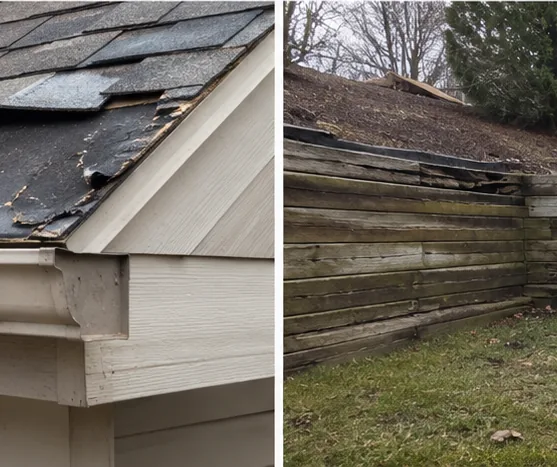
Sign
Lifted & creased tabs
Shingles that have lost their seal flap and crease — the most common and most overlooked wind damage.
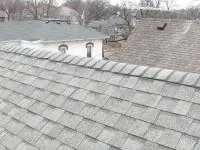
Straight-line winds rarely take a whole section of roof — they quietly break the seals that hold shingles down. Here's how wind damage works, the signs to look for, and how we find the hidden lifted tabs.
We inspect the windward edges and ridges for broken seals and lifted tabs on every 120-point inspection. Get a free quote and book online.
Each asphalt shingle is glued to the one below by a heat-activated sealant strip. Wind damage starts when gusts get under the leading edge of a shingle and pry it up, breaking that seal. Once unsealed, the tab flaps with every breeze, fatigues, and eventually creases or tears away. The worst uplift lands on the windward edges, ridges, hips, and corners of the roof.
The Hutchinson area sees severe thunderstorms with straight-line winds and the occasional microburst every season. The damage that matters most is often invisible from the ground — unsealed and lifted shingles that let wind-driven rain underneath. Wind damage commonly travels with hail damage and accelerates shingle aging. We document it in the roof inspection of the full 120-point inspection.
Get Your Free Quote →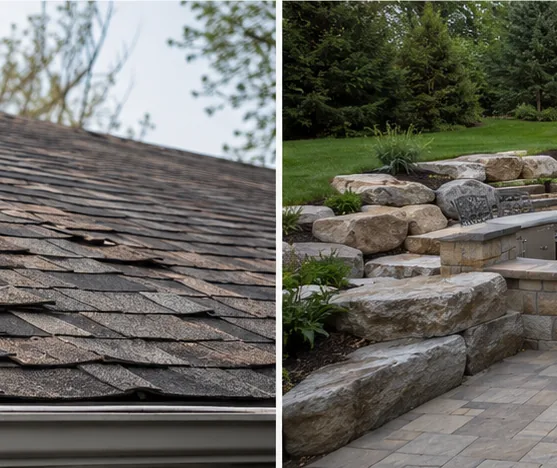
Some of it is obvious; the costly part usually isn't.
Shingles that have lost their seal flap and crease — the most common and most overlooked wind damage.
Bare patches and shingle debris in the yard expose the deck and underlayment to the next storm.
Unsealed shingles let rain blow underneath, leading to attic moisture and ceiling stains over time.
Tabs that look fine but no longer adhere, leaving the roof vulnerable to the next gust.
One unsealed shingle exposes the next, so damage spreads with every subsequent storm.
Wind-driven rain gets under lifted tabs and shows up as roof leak signs inside.
Creased shingles expose nail heads that rust and become their own leak points.
Wind also peels back ridge caps, drip edge, and loosens flashing.
Gutters, fascia, and vent caps torn loose that misdirect water at the eaves.
We inspect the windward edges, ridges, hips, and corners where uplift concentrates.
We look for tabs that have lost adhesion and lift, not just shingles that are obviously missing.
In the attic we check for moisture from wind-driven rain getting under unsealed shingles.
Findings are photographed and prioritized in your 24-hour report for a roofer or insurer.
Wind damage runs alongside hail damage, asphalt shingle damage, roof leak signs, and chimney flashing leaks. See how we document the roof in our roof inspection and attic inspection, or browse the full defect library and complete home inspection. We serve Hutchinson and McLeod County.