
Panel
Breaker too big
A 20- or 30-amp breaker feeding 14-gauge wire rated for only 15 amps.
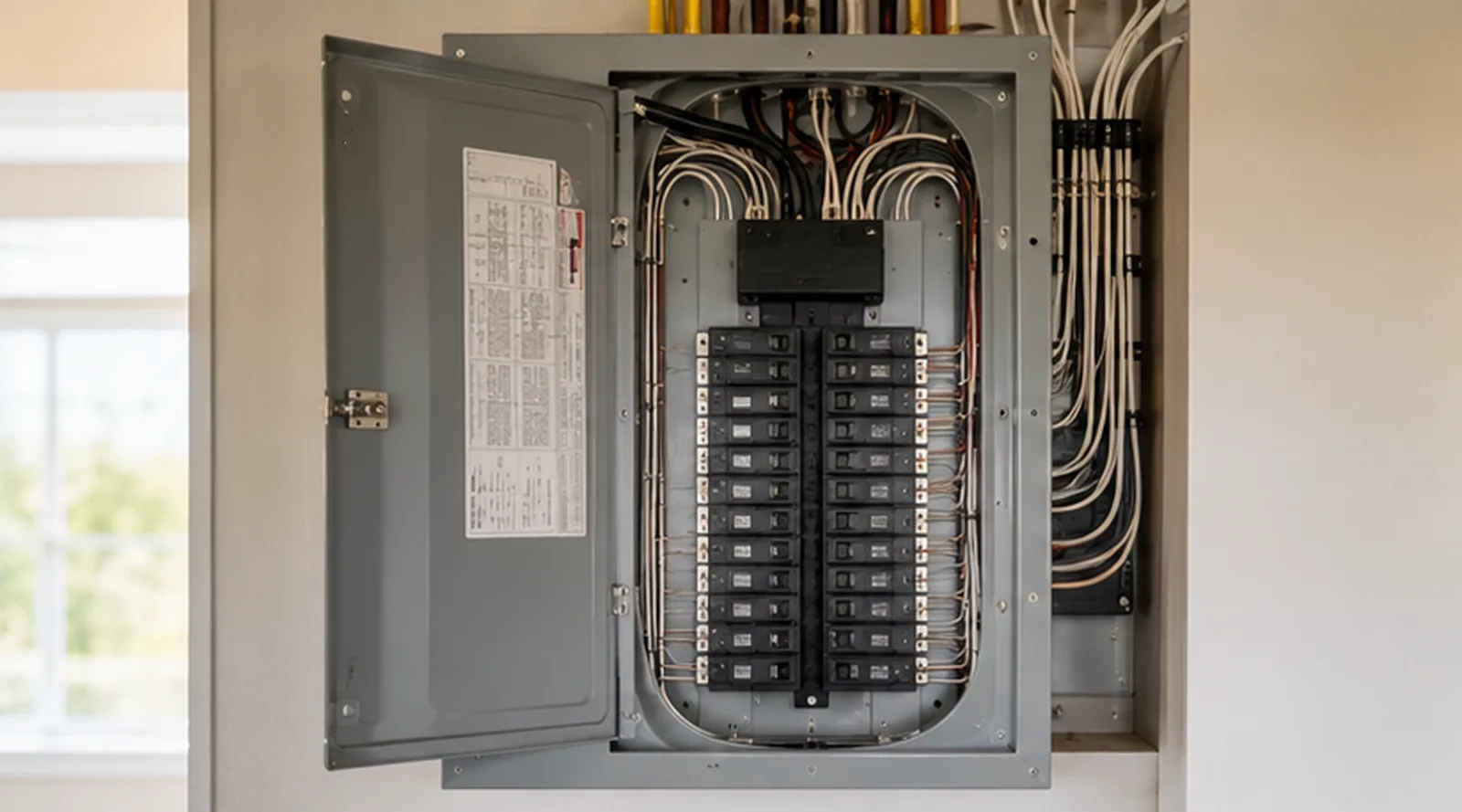
When a 20- or 30-amp breaker protects wire only rated for 15, the wire can overheat long before the breaker ever trips. It's a quiet fire risk we find in older Hutchinson panels — and it's invisible until you match breaker to wire.
Every standard electrical inspection covers this. Get your free instant quote, pick a time, and we'll document exactly what's there in a photo-rich report within 24 hours.
Overfusing means the breaker or fuse protecting a circuit is rated higher than the wire it feeds can safely carry. Wire is sized to a maximum current: 14-gauge for 15 amps, 12-gauge for 20 amps, and so on. The breaker is supposed to trip before the wire overheats. When someone installs a bigger breaker — often to stop "nuisance" tripping — the wire becomes the weak link, and it can overheat to the point of fire while the oversized breaker never reacts.
It's documented as part of the electrical inspection, one of the eight systems in the full 120-point inspection. Browse the full defect library to understand the other issues we catch in electrical systems.
Get Your Free Quote →
Overfusing usually starts as a misguided fix: a circuit keeps tripping, so someone swaps in a larger breaker or fuse instead of finding the overload. In older Hutchinson homes with original fuse panels, it's especially common — a blown 15-amp fuse gets replaced with a 20- or 30-amp one because that's what was in the drawer. The tripping stops, but the protection is now gone.
A 20- or 30-amp breaker feeding 14-gauge wire rated for only 15 amps.
Old fuse panels with whatever-size fuse fit the socket, removing protection.
An overfused circuit behaves normally right up until the wire overheats.
The breaker is the only thing standing between an overloaded circuit and an overheated wire. Overfuse it and the wire can heat up, degrade its insulation, and ignite inside a wall before the breaker ever trips — the protection has effectively been removed. Because everything works normally day to day, an overfused circuit gives no warning until it fails.
A licensed electrician corrects overfusing by installing a breaker or fuse properly sized to the wire it protects, or by upsizing the wire if the larger capacity is actually needed. Old fuse panels with mismatched fuses are often candidates for replacement. We document each mismatch by reading the breaker rating against the wire gauge; we don't quote the work.
A breaker rated higher than the wire it feeds can safely carry.
Larger fuses installed in old panels to stop nuisance tripping.
Thinner wire spliced into a circuit protected to the larger size.
An oversized breaker that won't trip before the wire overheats.
Breakers swapped without matching rating to wire gauge.
Warm or degraded wire feeding off an overfused circuit.
We note the amperage rating of every breaker and fuse in the panel.
Breaker ratings are checked against the gauge of the wire they protect.
Any breaker too large for its wire is documented as a safety item.
Overfused circuits are flagged for a licensed electrician to correct.
Older Hutchinson and McLeod County homes still running original fuse panels are where we find overfusing most often — a blown fuse replaced with whatever larger size was on hand. We always cross-check breaker and fuse ratings against wire gauge so an oversized fuse doesn't slip past with the cover on.
Get Your Free Quote →Explore more in the Defect Library, or read about related issues: Double-tapped breakers, Federal Pacific panels, Aluminum wiring, Missing GFCI. See how this fits into our electrical inspection and the full 120-point home inspection. We serve Hutchinson and McLeod County.